Apply For Membership: Pathways and Process
If you are involved in education and scholarship at Kaiser Permanente Northern California, we encourage you to apply for membership. Depending on your primary area of contribution, you can apply for a faculty appointment in one of following pathways. Within each pathway, you can choose which rank to apply for based upon your portfolio of work. Learn more about the specific criteria required for the ranking within each pathway below.
This pathway is meant for clinician educators whose predominant academic work is based in the education of students, trainees or colleagues.
| Adjunct Faculty | Clinical Instructor | Assistant Professor | Associate Professor | Professor | Emeritus Professor | |
|---|---|---|---|---|---|---|
| Time at rank before promotion (not applicable to initial appointment) | 2 years | 5 years | 6 years | N/A | N/A, only available to full Professors. | |
| Teaching hours in the 2 years prior to application. This includes teaching of medical students, residents, fellows, peers, and/or interprofessional teams in a clinical setting. | 20 hours annually | 20 hours annually | 30 hours annually | 40 hours annually | 50 hours annually | Encouraged, if feasible with retirement rules |
| Participation in professional development in the 2 years prior to the application. This includes attendance in lectures, conferences or other training germane to skills in education or teaching. | Plan to attend | 2 hours annually; optional for initial appointment (required for promotion) | 2 hours annually; optional for initial appointment (required for promotion) | 3 hours annually; optional for initial appointment (required for promotion) | 4 hours annually; optional for initial appointment (required for promotion) | 2 hour annually |
| Areas of Contribution required (see “Areas of Contribution”). | Plan to contribute | 2 | 3 | 3 | 4 | 1, if feasible with retirement rules. |
| Recognition in any of the Areas of Contribution. | Not required | Not required | Not required | Regionally Recognized | Nationally Recognized |
This pathway is meant for clinicians or primary researchers whose predominant academic work is based in clinical investigation.
| Adjunct Faculty | Instructor | Assistant Professor | Associate Professor | Professor | Emeritus Professor | |
|---|---|---|---|---|---|---|
| Time at rank before promotion (not applicable to initial appointment) | 2 years | 5 years | 6 years | N/A | N/A, only available to full Professors. | |
| Breadth and Dissemination of Scholarly Work. This includes peer reviewed manuscripts, monographs, books, and chapters, as well as oversight of research teams, acquisition of grant funding, committee service related to research, invitations to speak about research or awards for research achievement. | Local | Local | Regional | National | National to International | National or International |
| Educational engagement in the 2 years prior to the application with medical students, residents, fellows, peers, and/or interprofessional teams on research and/or scholarly projects. | Intent to engage | 20 hours annually | 20 hours annually | 25 hours annually | 30 hours | Encouraged, where feasible, with retirement rules. |
| Areas of Contribution required (see “Areas of Contribution”). | Intent to contribute | 2 | 3 | 3 | 4 | 1, if feasible with retirement rules. |
| Recognition in any of the Areas of Contribution. | Not required | Not required | Not required | Regionally Recognized | Nationally Recognized |
This pathway is meant for non-clinical educators whose predominant academic work is based in administrating, supporting and promoting educational activities.
| Medical Education Administrator | Assistant Professor of Practice, Administration | Associate Professor of Practice, Administration |
Professor of Practice, Administration |
Emeritus Professor of Practice, Administration | |
|---|---|---|---|---|---|
| Time at rank before promotion (not applicable to initial appointment) | 2 years | 5 years | 6 years | N/A | N/A |
| Dedicated hours to administrative work in medical education or scholarship in the 2 years prior to application. This includes efforts across all domains of UME, CME or GME (including research and simulation/assessment) in partnership with local Program Directors, Directors of Medical Education, the Regional Medical Director, local CME chiefs, other faculty, fellows, residents, medical students, peers and/or interprofessional teams on medical education. | Average of 12h weekly | ≥ 20h weekly | ≥ 20h weekly | ≥ 20h weekly | Encouraged, where feasible, with retirement rules. |
| Breadth of participation in broader educational fora. This includes committees, presentation at medical education meetings, publishing as a collaborating author, or serving as an investigator on an education-related grant. | Not required | Not required | Regional | National | Encouraged, where feasible, with retirement rules. |
| Direct contribution to advancement of the Kaiser Permanente Northern California Institute of Medical Education (KPNC IME). This includes development, implementation, administration, and/or evaluation of activities within the IME in any capacity. | Not required | Required | Required | Required | Encouraged, where feasible, with retirement rules. |
| Areas of Contribution required (see “Areas of Contribution” tab). | 1 | 2 | 2 | 3 | 1 |
Application is under maintenance. Come back soon.
KP NCAL Institute for Medical Education Areas of Contribution
| Areas of Contribution | Potential Evidence of Achievement |
|---|---|
| Assessment | Development of assessment outcomes; innovations in approaches to assessment; adoption of assessment approaches by other entities; dissemination of assessment methodologies or tools; grants for development or implementation of assessment tools; awards for assessment approaches. |
| Community Engagement | Health or science-related volunteer activities in the community (from local to global); development of patient education materials; service in public health roles within the community; invitations to speak to community groups; engagement with the lay press on clinical topics; community awards, government service. |
| Contributions to Equity, Inclusion, and Diversity (EID) | Service on committees to enhance EID; efforts to increase the diversity of the healthcare workforce; pathway/pipeline activities; invitations to speak about EID-related topics; efforts to improve access to care for vulnerable populations; participation in EID-related Business Resource Groups or other organizations focused on EID; awards for contributions to EID. |
| Curriculum Development | Documentation of sessions or courses developed; review by students or peers of sessions or courses developed; innovation in curricular content; adoption of the curriculum by other entities; efforts to create an inclusive curriculum; novel utilization of technology for educational purposes; awards for curriculum development. |
| Faculty Development | Creation and administration of faculty development programs; assessment of faculty development programs; innovations in the administration of faculty development; invitations to speak about faculty development; awards for faculty development. |
| Funding | Acquisition of funding, external or intramural, to support academic activities; quantity of funding; source of funding. |
| Leadership and Administration | Contributions in leadership roles; committee leadership; providing leadership training to peers; leadership awards; course directorships; invitations to participate in professional societies; oversight of policy development; oversight and management of research teams. |
| Mentorship | Number of mentees; feedback from mentees; outcomes of mentees; innovation in mentorship; awards for mentorship. |
| Quality Improvement (QI) | Documented role in QI initiatives; outcome measures of the impact of QI initiatives; training of others in QI methods; awards associated with QI activities; invitations to speak about QI. |
| Scholarship | Dissemination (which will often take the form of publication) of reviews, chapters, original research, curriculum, and other forms of scholarship; invitations to speak regarding scholarly findings; service as a journal reviewer; and awards for scholarly work. |
| Service | Participation on committees; volunteering to assist with school-related programs; efforts to enhance and support the school culture and well-being organization; study section participation. |
| Journalism/Media | Articles in newspapers, magazines, blogs, interviews with media, news outlets, and education on social media such as Instagram or LinkedIn. |
| Teaching Activities | This includes teaching of medical students, residents, fellows, peers, and/or interprofessional teams in a formal didactic setting, including classroom, small group, professional conference or CME lectures. |
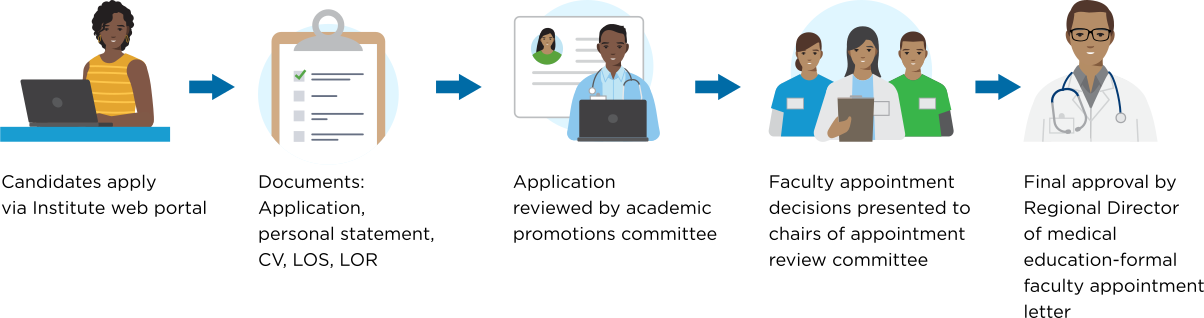
Application Process